


Cessna Citation Mustang Aircraft Liquidity and Selling Strategy
Home » News » Aircraft For Sale News »
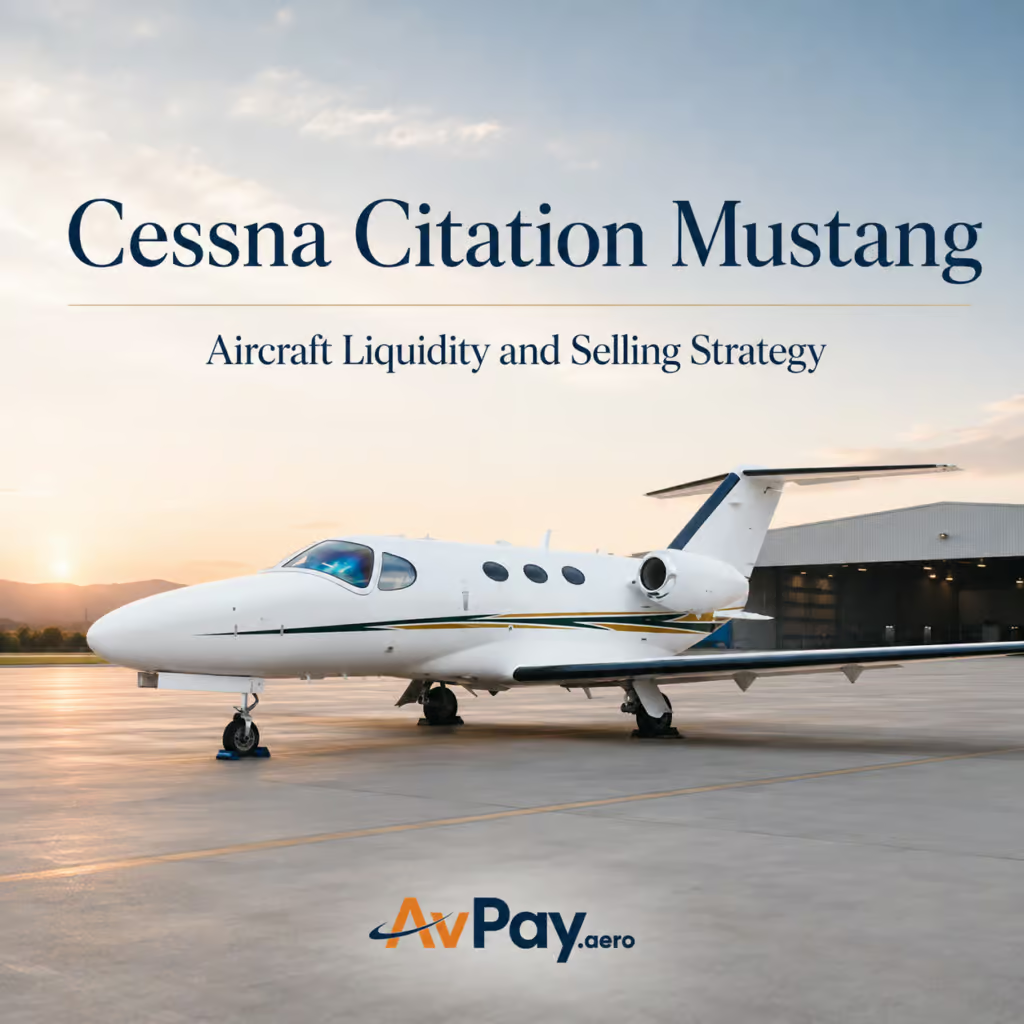
Market analysis — very light jet
The numbers behind the Citation Mustang’s pre-owned market performance are worth paying attention to. This was the top-selling pre-owned business jet in the 12 months to April 2024, recording approximately 90 transactions at an average rate of 7.5 per month. For sellers, understanding why the Mustang moves at that pace, and what separates the aircraft that close quickly from those that don’t, is the most commercially useful place to start.
The Cessna Citation Mustang, designated Model 510, entered service in 2006 as the first Very Light Jet to receive FAA certification, beating its contemporaries to market and establishing a template for single-pilot jet ownership that the category has been built around ever since. Powered by twin Pratt & Whitney Canada PW615F turbofans, each producing 1,460 pounds of thrust, the aircraft carries four passengers to a maximum range of approximately 1,150 nautical miles at a high-speed cruise of 340 knots, operating from runways as short as 3,110 feet and climbing to a service ceiling of 41,000 feet. The Garmin G1000 avionics suite, familiar to pilots transitioning from late-model piston singles, made the flight deck one of the most approachable in jet aviation. The High Sierra Edition, announced in July 2010, added synthetic vision technology to the G1000, enhanced cabin furnishings and a distinctive exterior package that remains a premium differentiator in the current pre-owned pool. Production ran from 2006 to 2017, at which point Cessna ended the programme following declining sales caused by the introduction of its own Citation M2. A total of 479 examples were delivered, and approximately 472 remain in operation as of mid-2026. Every one of them is pre-owned. No new examples exist. Understanding that fixed supply, combined with the consistently active demand that drives the type’s transaction volumes, shapes everything a seller needs to know.
Current Market Demand
|
Total Built 479 All examples produced 2006 to 2017; approximately 472 remain in operation |
H1 2026 Market ~20 to 28 Approximate examples visible on international market Jan to Jun 2026 |
Typical Price Range $1.5M to $2.4M Early 2007 models from $1.5M; late 2016 to 2017 models to $2.4M |
During the first half of 2026, approximately 20 to 28 Citation Mustang examples were visible across major pre-owned aircraft platforms. At approximately 7 percent of the active fleet for sale at any given point, the Mustang trades at a higher turnover rate than most comparable types, reflecting a buyer pool that is both broad and consistently active. Asking prices during H1 2026 ranged from $1.495 million for earlier 2007 to 2008 examples through to $2.395 million for the most desirable late-model, low-time, fully enrolled 2016 to 2017 aircraft. The Aircraft Bluebook Spring 2025 data confirmed a price range from approximately $1.25 million for the first 2006 model year examples to $3.05 million for a pristine 2017 aircraft, representing the full production span. The Mustang’s position at the most accessible end of the jet ownership market means its buyer pool is larger than almost any other type at a comparable price: experienced pilots stepping up from turboprops, Cirrus owners making their first jet transition, small businesses entering managed ownership and European charter operators all compete for quality Mustang inventory. This breadth of demand creates a predictable and liquid market for sellers who present their aircraft appropriately.
Speed of Sale and Buyer Demand
The Citation Mustang’s transaction velocity is one of its most commercially significant characteristics, and it operates in both directions: aircraft that meet buyer expectations move quickly, and aircraft that don’t meet them can sit on the market for extended periods in a pool of 20 or more competing listings. The type’s historically high transaction rates, approximately 7.5 per month recorded in 2024, reflect how well the Mustang fits its target market rather than a shortage of supply. Buyers for this aircraft are typically decisive once they find a suitable example: the acquisition price is within reach of a wider audience than most jets, the operating economics are well understood, the Garmin G1000 cockpit is familiar, and the maintenance programmes available through both Pratt & Whitney Canada and third-party providers give buyers cost certainty that reduces hesitation. Where listings spend excessive time on the market, the cause is almost always one of three factors: price expectations that exceed what the current market supports for the specific condition and model year, an aircraft with approaching or overdue maintenance events that buyers have calculated into their offer, or a listing that does not give buyers the information they need to engage. Sellers who address all three of these before going to market consistently achieve quicker transactions and stronger outcomes than those who don’t.
What Buyers Typically Look For
Citation Mustang buyers at this price point tend to be well-researched. The type’s maturity means there is no shortage of operator knowledge in the buyer community, and pre-purchase inspectors familiar with the Mustang know exactly what to look for. The factors below shape buyer decisions and negotiating positions across the current market.
| Engine programme enrollment (PowerAdvantage+, ESP Gold or JSSI) | Critical | |
| Engine time since overhaul or hot section (TBO 3,500 hrs, HSI at 1,750 hrs) | Critical | |
| Airframe programme enrollment (ProParts or ProTech) | Critical | |
| G1000 NXi avionics upgrade with ADS-B In and Out compliance | Critical | |
| WAAS/LPV approach capability and current avionics database subscriptions | High | |
| No damage history with complete, unbroken logbooks from new | High | |
| Doc 11 and Doc 32 inspection status (72-month events) | High | |
| High Sierra Edition designation (synthetic vision, premium interior) | Medium | |
| Recent paint and interior condition relative to age | Medium | |
| Low total time or total cycles (low cycles matters independently of hours) | Medium |
Engine programme enrollment shapes Citation Mustang transactions more decisively than any other single factor. The PW615F engines are exclusive to this aircraft, meaning the parts pool is finite and the cost of an overhaul at the 3,500-hour TBO interval is significant. Buyers who encounter an aircraft with approaching overhaul intervals and no programme coverage will calculate the worst-case cost directly into their offer. Aircraft enrolled on PowerAdvantage Plus, ESP Gold or a third-party equivalent give buyers the predictable hourly cost structure that converts hesitation into commitment. The Garmin G1000 NXi upgrade is the avionics development that matters most in the current buyer pool: the original G1000 suite was excellent when new, but ADS-B Out compliance and WAAS/LPV capability are now baseline expectations rather than optional extras. Listings showing the NXi upgrade consistently attract faster enquiry conversion than those with the original G1000. The Doc 11 and Doc 32 inspections, due every 72 months, are the major airframe events that buyers factor into their due diligence; a recently completed example of either removes one of the most common post-inspection price negotiation triggers.
Competing Aircraft Models
Three aircraft consistently appear in the shortlists of buyers evaluating a Citation Mustang, and the competitive dynamic each creates is worth understanding specifically rather than treating as a generic comparison exercise.
| Comparison factor | Citation Mustang | Embraer Phenom 100 | Cessna Citation M2 | Cirrus Vision Jet SF50 |
|---|---|---|---|---|
| Positioning | Subject aircraft | Main rival | Niche overlap | Niche overlap |
| Max cruise speed | 340 kt | ~389 to 406 kt | ~404 kt | ~311 kt |
| Max range (approx) | ~1,150 nm | ~1,178 nm | ~1,550 nm | ~1,200 nm |
| Cabin height / width | 4 ft 6 in / 4 ft 6 in | 4 ft 11 in / 5 ft 1 in | 4 ft 9 in / 4 ft 9 in | 3 ft 10 in / 4 ft 7 in |
| Avionics | Garmin G1000 | Garmin G1000/Prodigy | Garmin G3000 | Garmin G1000 NXi |
| Single-pilot certified | Yes | Yes | Yes | Yes |
| Takeoff field (std day) | ~3,110 ft | ~3,720 ft | ~3,000 ft | ~2,036 ft |
| Typical pre-owned price | $1.5M to $2.4M | $2.0M to $3.5M | $3.85M to $4.9M | $1.5M to $2.5M |
The Embraer Phenom 100 is the most direct and most frequently cited competitor for the Mustang, and the comparison follows a well-worn pattern: the Phenom 100 offers a wider, taller cabin with greater overall volume, flies faster by approximately 50 to 65 knots at cruise and comes from a manufacturer with strong product support. Against this, the Mustang consistently wins on acquisition price, operating economics and runway performance, with a takeoff field length of 3,110 feet versus the Phenom 100’s approximately 3,720 feet. Buyers who are choosing between both typically settle on the Phenom if cabin size is a priority and the Mustang if operating cost and airport access are. Sellers competing with Phenom 100 listings should foreground the lower annual operating budget, the shorter runway requirement and the Textron support network’s global reach. The Citation M2 competes from a different angle: it is a larger, faster aircraft from the same manufacturer with more range and a more modern avionics suite, and buyers comparing both are making a genuine step-up decision rather than a lateral one. The price gap between a well-maintained Mustang and a comparable Citation M2 of approximately $2 million to $2.5 million is the decisive number in that comparison. Buyers who conclude that the M2’s capabilities justify the premium will move on; those who don’t will find the Mustang a well-supported, well-understood aircraft at a price point that remains very accessible. The Cirrus Vision Jet, which carries a similar pre-owned price point, competes for the same first-time jet owner audience, particularly pilots already flying Cirrus SR22 aircraft who are familiar with Garmin and the Cirrus ecosystem. The Vision Jet’s single engine limits some buyers despite its approachable economics, while its shorter takeoff field and ultra-low fuel burn attract those for whom operating simplicity and cost matter most. Sellers of the Mustang competing with Vision Jet listings should lead with the twin-engine reliability argument, the greater range, the larger cabin and the broader type rating community that supports the Mustang.
✈️Click here to find Embraer Phenom 100 For Sale on AvPay
✈️Click here to find Cessna Citation M2 For Sale on AvPay
✈️Click here to find Cirrus Vision Jet For Sale on AvPay
What Separates Premium Examples from Average Examples?
✓ Premium Citation Mustang examples
| 2014 to 2017 model year, ideally High Sierra Edition with synthetic vision | |
| Both engines fully enrolled on PowerAdvantage Plus, ESP Gold or equivalent | |
| Garmin G1000 NXi upgrade completed with ADS-B In and Out | |
| ProParts and ProTech airframe programmes enrolled | |
| Fresh recent Doc 11 or Doc 32 inspection (72-month event) completed | |
| Low total time with matched low-cycle engines and no hot section coming due | |
| Always hangared, no damage history, single corporate or owner-operator pedigree | |
| Refreshed paint and interior in excellent condition relative to aircraft age |
✗ Below-average Citation Mustang examples
| 2006 to 2008 model year with high total time and no recent engine overhaul | |
| Engines not enrolled on a programme with overhaul interval approaching | |
| Original G1000 avionics with no NXi upgrade and no ADS-B Out compliance | |
| No airframe programme coverage and inconsistent maintenance history | |
| Doc 11 or Doc 32 coming due with no recent completion | |
| Part 135 charter history with higher cycle counts than hour counts suggest | |
| Undisclosed or poorly documented damage history or prior repair work | |
| Tired original interior and paint with no refurbishment investment |
Common Seller Mistakes
The Mustang’s active market creates a specific set of seller pitfalls that are worth knowing before listing. The most common is pricing based on what the seller paid or invested in the aircraft, rather than where comparable examples are currently transacting. With 20 or more competing listings visible simultaneously on major platforms, buyers can construct their own price benchmarks within minutes, and an aircraft priced above comparable examples without a clear justification grounded in condition, low time or recent upgrades will be passed over in favour of the next listing down the page. A second common error is listing with approaching or overdue maintenance events and expecting buyers to factor the cost into the purchase price on a like-for-like basis. In practice, buyers add a risk premium on top of the direct cost of any identified maintenance event, and the net effect is a price reduction greater than the actual work would have cost. A third mistake specific to this type is failing to address the G1000 NXi upgrade before listing: the original G1000 without ADS-B Out is now a visible and known gap that buyers who understand the type will note in the first paragraph of any listing they read, and its presence will shape every subsequent negotiation. Sellers who address these three items before going to market consistently achieve better outcomes than those who leave them as buyer discoveries during due diligence.
Summary on the Citation Mustang Sales Market
The Cessna Citation Mustang sits at the accessible end of the jet ownership market and trades accordingly. With 479 examples produced, approximately 472 in operation and approximately 20 to 28 visible on the international market during the first half of 2026, the supply and demand balance supports sellers who present competitive, well-prepared aircraft. The type’s consistently strong transaction volumes, driven by a buyer pool that spans first-time jet owners, piston-to-jet transitions and European charter operators, means that liquidity is not the challenge. The challenge is differentiation within a pool of competing listings where buyers are well-informed and have multiple alternatives within reach. Sellers who address engine programme enrollment, complete the G1000 NXi upgrade, keep their inspection events current and price with reference to where the market is actually transacting will find the Citation Mustang market receptive and active.
Sell your Citation Mustang on AvPay!
AvPay gives Citation Mustang sellers access to a global buyer audience through dedicated aircraft listings, social media promotion to over 170,000 followers, and a Weekly Update Email that puts your aircraft directly in front of buyers tracking the very light jet market. The Mustang sells strongly in both North American and European markets, making international platform visibility a practical advantage rather than just a marketing preference.
Click here to view Cessna Citation Mustang aircraft currently listed for sale on AvPay. If you are selling a Citation Mustang and want to connect with buyers around the world, register here to list your aircraft on AvPay today.
Key takeaways for sellers
- The Citation Mustang recorded approximately 90 transactions in the 12 months to April 2024, making it one of the highest-liquidity pre-owned business jets at any price point
- With 20 to 28 examples on the international market in H1 2026, sellers are competing directly with multiple alternatives; preparation and pricing discipline are essential
- Engine programme enrollment is the single most commercially decisive factor; unenrolled aircraft with approaching overhaul intervals face buyer price adjustments that exceed the actual cost of the work
- The Garmin G1000 NXi upgrade with ADS-B Out is now a baseline buyer expectation; original G1000 aircraft are noted and discounted accordingly in the current market
- The High Sierra Edition commands a measurable premium in the pre-owned market due to its synthetic vision capability and premium interior package
- Doc 11 and Doc 32 (72-month inspections) are the airframe events that most commonly trigger post-inspection price renegotiation; completing them before listing retains negotiating leverage
- European buyer interest is a consistent secondary market for the Mustang; listing on platforms with genuine international reach is a practical step, not optional