

Home » Aircraft for Sale » Motor Gliders for Sale
Motor Gliders & Motorized Sailplanes for Sale
Find new and used motor gliders and motorized sailplanes for sale on AvPay, the premier global marketplace for self-launching, touring and general aviation. Search our comprehensive aircraft listings for high-performance motor gliders from leading international manufacturers such as Stemme, A-I-R, Pure Flight, Diamond and more...
As a leading digital platform for autonomous soaring and touring motor glider (TMG) procurement, our global inventory supports private syndicates, long-distance soaring pilots and club training operations across the UK, Europe, the United States and beyond. Whether you are looking to purchase a high-aspect-ratio self-launching sailplane directly, source versatile touring motor gliders through established aircraft brokers or connect with private sellers worldwide, AvPay seamlessly bridges the gap between buyers and high-efficiency hybrid-lift assets across the USA, North America, South America, Asia, Africa and Australasia. From advanced retractable-engine competition models to rugged front-engine cross-country cruisers, find your next self-contained soaring asset on a trusted marketplace built for international aviation professionals.












Find Your Ideal Motor Glider for Sale on AvPay
AvPay, the premier global marketplace for self-launching and touring motor gliders, connects discerning pilots, cross-country soaring syndicates and specialized aircraft dealers across the UK, Europe, North America, South America, Asia, Africa and Australasia. Our centralized digital network hosts an elite online selection of new and pre-owned motor gliders and motorized sailplanes designed for unassisted launch flexibility, high-efficiency cross-country touring and performance soaring.
Refine your hybrid soaring search parameters smoothly using our integrated filtering infrastructure. You can quickly isolate your ideal aircraft by filtering the marketplace by manufacturer, specific model, condition, year of manufacture, total time on airframe (TTAF), geographic location, price and specialized seller.
As an authoritative platform tailored to touring motor glider (TMG) operators, performance soaring syndicates and flight training organizations, AvPay showcases a diverse range of high-aspect-ratio motorized soaring inventory. Discover our complete selection of motor gliders listed on this page, or browse all alternative aircraft categories and aerospace manufacturers here.
Once you locate a motorized sailplane asset that aligns with your operational profile, connect instantly with the listing broker or private seller via WhatsApp, secure private message or phone to discuss engine extension lifecycles, feathering propeller mechanics, avionics packages, fuel burn rates and pricing details.

Why buy a Motor Glider or Motorized Sailplane For Sale?
✈ Unmatched Multi-Mission Versatility: Motorized sailplanes provide the ultimate operational compromise, bridging the gap between unpowered performance soaring and predictable fixed-wing powered flight. This dual capability allows pilots to enjoy extended engine-out thermalling configurations or switch smoothly to sustained powerplant cruising depending on weather changes.
✈ Autonomous Operational Self-Launch Liberty: Equipping a high-aspect sailplane with an auxiliary propulsion system eliminates the logistical need for traditional tow-planes, ground crew networks or winch launching systems. Pilots can taxi, perform run-up checks and launch completely independently from standard regional airfields.
✈ Enhanced Safety Infrastructure and Redundancy: Operating a motor glider introduces an excellent layer of cross-country safety. Encountering dropping thermal lift or unexpected headwind barriers does not force an off-field landing, as pilots can simply restart the internal powerplant to return safely to base.
✈ Expansive Touring Range and Long-Distance Endurance: Utilizing efficient, low-consumption powerplants alongside high-glide-ratio aerodynamics unlocks impressive point-to-point cruising range. TMG platforms allow operators to execute expansive cross-country expeditions across multiple airspaces with minimal fuel stop dependencies.
✈ Refined Low-Impact Environmental Sustainability: Motor gliders maintain a highly responsible environmental footprint compared to traditional fixed-wing aircraft. Their aerodynamic shapes allow for minimal power output requirements during cruise, generating exceptionally low emissions and reduced external acoustic signatures.
✈ Active Global Touring Motor Glider Network: Sourcing a motorized sailplane integrates you into a passionate, highly technical international soaring fraternity. Share custom mechanical insights, trade efficient routing approaches and join collaborative regional fly-ins, TMG rallies and long-distance soaring challenges.
✈ Suppressed Operational and Ownership Overhead: Lacking the high fuel demands and intense maintenance requirements of heavy general aviation platforms, motor gliders feature highly competitive running costs. Shared syndicate agreements keep hangarage, insurance and licensing fees remarkably affordable.
✈ Advanced Aerospace Composite Engineering: Modern motorized gliders integrate sophisticated carbon-fibre construction, retractable engine bays, low-drag feathering propellers and integrated glass flight decks that continuously track glide angles, lift-to-drag metrics and thermal tracking coordinates.
Motor Gliders are ideal for
✈ Autonomous Cross-Country and Competition Pilots: Providing performance-minded soaring aviators with maximum geographic independence, allowing for long-distance FAI badge pursuits without tow-plane availability constraints.
✈ Touring Motor Glider (TMG) Syndicates: Delivering a highly versatile, shared aviation asset optimized for cost-efficient point-to-point regional touring and traditional weekend leisure flights.
✈ Advanced Flight Academies and Soaring Clubs: Providing training organizations with a flexible asset for teaching advanced stick-and-rudder coordination, precision engine-out management and sophisticated micro-meteorology navigation.
✈ Long-Range Environmental Tracking and Research: Serving as a vibration-free, highly efficient aerial platform for low-altitude wildlife monitoring, forestry protection surveys, atmospheric sampling and eco-assessments on a micro-budget.
✈ Stable Aerial Cinematography and Photography: Offering creative media teams a smooth, aerodynamic camera platform that can secure stunning aerial video and terrain tracking footage with minimal structural cabin vibration.
✈ Aviation Enthusiasts Seeking Personal Milestones: Providing a deeply rewarding, technical flying outlet for pilots who enjoy balancing the finesse of silent soaring with the utility of mechanical propulsion systems.
Get help buying a Motor Glider Aircraft
Can't locate the specific retractable engine layout, side-by-side touring motor glider structure or glide-ratio metric your operations demand? Bypassing the current stock inventory list layout is simple. Contact an established sport aviation professional through our global Aircraft Broker Directory to initiate a dedicated search. Alternatively, explore tailored Aircraft Brokerage and Aircraft Acquisition Services via our aviation marketplace to professionalize your next motorized sailplane purchase.
For highly targeted performance specifications or rare composite configurations, you can also submit a bespoke request form. We will distribute your precise procurement criteria directly to our global networks of aircraft brokers, specialized soaring dealers and factory contacts to help uncover premium off-market motor glider choices matching your parameters.
Sell your Motor Glider & Motorized Sailplane on AvPay
Maximise your market exposure by listing your motor gliders and motorized sailplanes on AvPay to engage qualified aviation buyers worldwide. Offering streamlined DIY options, our platform automatically updates and distributes your listings, publishing every new aircraft directly to our dedicated aviation social media channels and including them in our weekly email blast to put your assets in front of our audience of 190,000+ followers and subscribers.
For professional aircraft brokers, our dedicated broker packages feature unlimited listings with automated distribution, ranging from 1 month for $199, 3 months for $349, 6 months for $599, up to 12 months for $999.
For private single-aircraft sellers, our private seller options provide simple and affordable DIY plans to list one aircraft for either $25 for 1 month or $50 for 3 months.
With AvPay, you will not just generate inquiries on your core inventory. You will also build long-term digital authority through your aircraft broker profile and any additional service listings you include on our aviation marketplace pages. Let us streamline your remarketing efforts. List your Motor Gliders and Motorized Sailplanes on AvPay Today!
Motor Gliders for sale on AvPay FAQ
Gliders (also known as sailplanes) are aircraft similar in general structure to an airplane, but without an engine. Flight is supported by rising currents of air, however some gliders are equipped with a means of propulsion (MoP), making them capable of continuous flight and are sometimes even capable of self-launching.
A glider needs help to get into the air. Normally it is either towed into air by powered aircraft (aerotow) or kited up using powerful winch (winch launch). Some clubs that are located at the top of hills or ridges launch by means of bungee. Once launched, sailplanes stay airborne by making use of the rising currents of air, soaring by means of lift produced by thermals and wind deflecting upward by mountain ridges.
Motor gliders are able to self-launch by means of a built-in engine and are mostly certified to carry one or two occupants. Most motor gliders are limited to a Maximum Take-Off Weight (MTOW) of 2,200 lbs (850kg), however there are some exceptions such as the Grob Vigilant TMk1, which had a MTOW of 908kg. Motor gliders can be equipped with a fixed pitch, variable pitch or retractable propeller.
A Touring Motor Glider is fitted with an internally mounted, non-retractable engine and fixed or variable pitch propeller. It is a specific class of powered sailplane that has the capability of taking off and climbing under its own power.
Retractable propellers are typically mounted on a mast that rotates upwards and forwards from the fuselage, to the rear of the cockpit. The engine is normally situated near the top of the mast, however in newer motor glider designs the engine is fixed in the fuselage, reducing drag and noise. The engine bay doors open and close automatically, much the same as landing gear doors.
Sustainer motor gliders have to be launched by either aerotow or winch. The engine of a sustainer motor glider typically comprises of a two stroke 18 – 30hp air cooled engine with no alternator or starter motor. In order to get the engine to start, sustainer motor gliders make use of wind milling the propeller. Because the sustainer motor glider is not equipped with a throttle, it makes use of a cable to open and close the decompression valves of each cylinder, allowing the engine to turn easily for starting.
Self-launching motor gliders are equipped with an engine that provides it with enough thrust and initial climb rate, allowing for unassisted take-offs from airfields. The engines normally have a starter motor, large battery and alternator. Self-launching motor gliders can be launched in the same fashion as conventional piston aircraft.
Cross Over Motor Gliders possess the ability to soar in ridge, wave or thermals and the capacity to fly cross country as a Touring Motor Glider, for example the AMS Flight Carat A motor sailplane.
Electrical Motor Gliders are not fitted with an internal combustion engine but make use of electric power to sustain flight but is unable to launch itself. The Schempp-Hirth Ventus 3, HPH Shark and ESAG LAK-17B all offer the option of FES for self-launching.
New generation Motor Gliders fitted with Jet engines includes the experimental LET L-13TJ Blanik, Jonker JS-1 Revelation and the Schempp-Hirth Ventus 2. The first motor glider with self-launch capability and fitted with a jet engine was the Caproni Vizzola Calif.
Historical classic motor gliders dating back to the 1930’s,40’s and 50’s have an unique charm to them, though unfortunately not many are still flying and are very rarely available for sale.
There are first generation glass fibre gliders from the 1970’s and 1980’s that are still operating and are very popular in mid-range budget. You can expect to pay anything from $10,000 up to $40,000 for gliders such as the Fournier RF-5, Scheibe SF.25C, Motorfalke, HB-Flugtechnik HB-21 Hobbyliner and Grob 109B.
Modern carbon/glass fibre gliders are built with precision performance in mind and are equipped with finely-tuned, high technology instruments that enhance glider performance, farther distance travelling and high speed.
- Jonker Sailplanes JS3 Rapture (New Approximately EUR €148,200*)
* The estimated cost of a Jonker Sailplane JS3 Rapture above is based on the airframe, 18m wingtips and equipped with the Jet engine.
Setting the bar in the 18m class, the JS3 Rapture is manufactured by Jonker Sailplanes founded by the two brothers Attie and Uys Jonker based in Potchefstroom, South Africa. The Jonker JS3 Rapture is renowned for its high-speed capability and its high wing design that reduces drag. The Jonker JS3 has a panoramic canopy providing the pilot with excellent visibility. The cockpit has been ergonomically designed with the instruments within comfortable reach of the pilot.
- Pipistrel Taurus LSA (New - approximately $105,000)
The Taurus LSA, manufactured by Slovenian aircraft company Pipistrel, is the only self-launched side-by-side two-seater glider that delivers all the advantages of a LSA category aircraft available on the current market. The Taurus LSA is capable of unassisted take-offs on short runways. The Taurus LSA is equipped with an Intelligent Engine Control System that is fully automated and ensures that the propeller is correctly positioned when the engine is retracted. The cockpit is spacious and comfortable, full dual controls are ergonomically positioned and there’s an aft baggage compartment located behind the seat to provide for ample storage.
- Sonex Xenos-B (Build and Fly $47,000)
Sonex Aircraft is a small manufacturing company producing the Xenos-B based at Oshkosh, Wisconsin in the United States of America. The Sonex Xenos-B is a lightweight, two-seater motor glider with low wing and a Y-tail. The Sonex Xenos-B is equipped with a dual screen glass cockpit, provided by MGL’s iEFIS Explorer 8.5” display system.
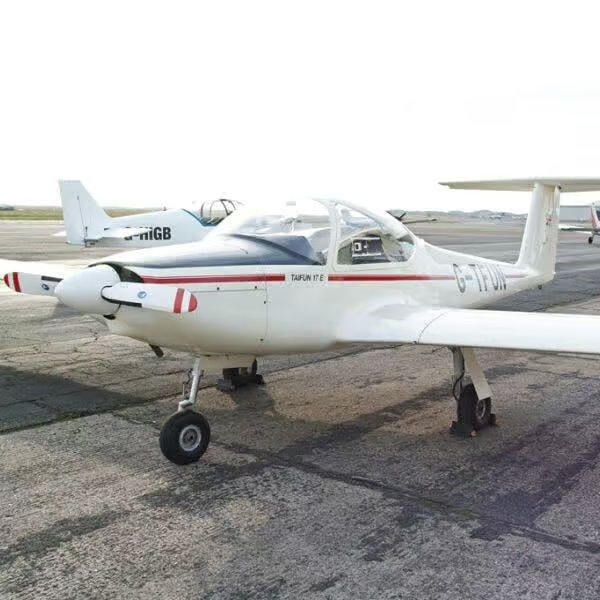
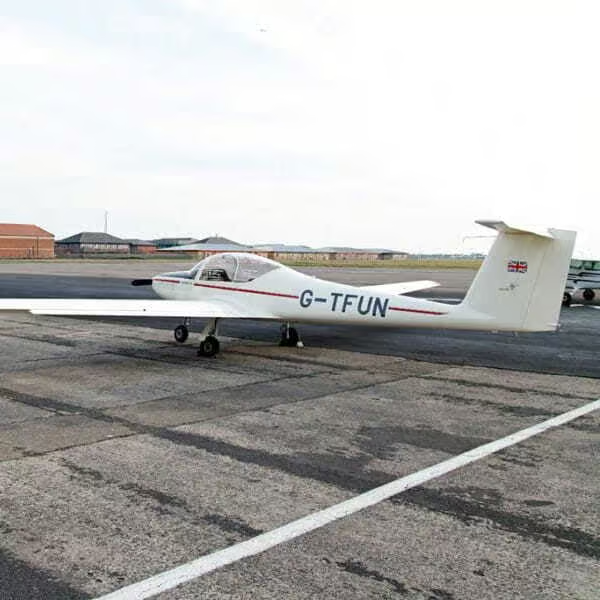
- Valentin Taifun 17E/E II Motor Glider (Pre-Owned – Average $45,000 - $65,000)
Designed and built by Valentin Flugzeugbau Gmbh in Hasfurt, Germany, the Valentin Taifun is a two-seater, self-launching low wing cantilever sailplane constructed from all glass-fibre with manually operated retractable tricycle landing gear.
- Grob G-109B (Pre-Owned – Average $40,000 - $55,000)
The Grob G109 first flew in 1980. It is a light two-seat, self-launching motor glider developed and produced by Grob Aircraft AG in Mindelheim Mattsies, Germany. The G109B replaced the G109A in 1984. The Grob G109B is powered by the Grob 2500 E1 or retrofitted Rotax 912 engine and is equipped with a two blade manually operated variable pitch propeller. Conventional controls are duplicated for both passenger and pilot’s seats.
A motor glider mainly uses its engine for launching itself and for sustaining flight in the air. It does not have a great fuel capacity and cannot therefore operate for an extended period of time utilizing its engine, relying on its soaring or gliding ability to sustain flight.
Aircraft, on the other hand, rely on an engine that burns fuel in order to operate. Normally it flies faster and farther than a motor glider but does not have the ability to glide very far unpowered.
Motor gliders have longer wings than Light Sport Aircraft, have lower stall speeds, generally have a slower rate of climb and have near-STOL capabilities.
For example, the two-seat Czech Pure Flight U15 Phoenix is fitted with a Rotax 912 (80 hp) petrol engine and only has a fuel capacity of 100l, but has an endurance of up to eight hours of flight with a 647nm (1200km) range cruising at a speed of VB 200km/h. Its glide ratio is 1:30. The wingspan of Pure Flight U15 Phoenix 49 ft 2 in (15m)
In comparison the Cessna 152 is an American two-seater aircraft with fixed tricycle landing gear. It is equipped with a Lycoming O-235-N2C 180 Hp engine, a fuel capacity of 38 US gallons with the ability to cruise at 105 kts over a 315nm (583 km) range. It has a glide ratio of 1.5 nm per 1000ft. The Cessna 152 has a wingspan of 33 ft 4 in (10.16m).
- Diamond DA20i Katana
Originating from the designs of Wolf Hoffman and initially introduced as the Hoffmann H36 Dimona, this touring motor glider was originally produced by Hofmann Flugzeubau. The Diamond DA20i Katana is currently being manufactured by Diamond Aircraft Industries.
The Diamond DA20i Katana is a side-by-side two-seater aircraft built from fibre-reinforced high-tech composite materials, ideally used for training and recreational purposes. The Diamond DA20i Katana is equipped with a Rotax 912 iSc3 Sport engine that produces 100hp and fuel grades include Avgas, Mogas and Super EN228 options. The Diamond DA20i Katana is also fitted with a two blade MT constant speed propeller.
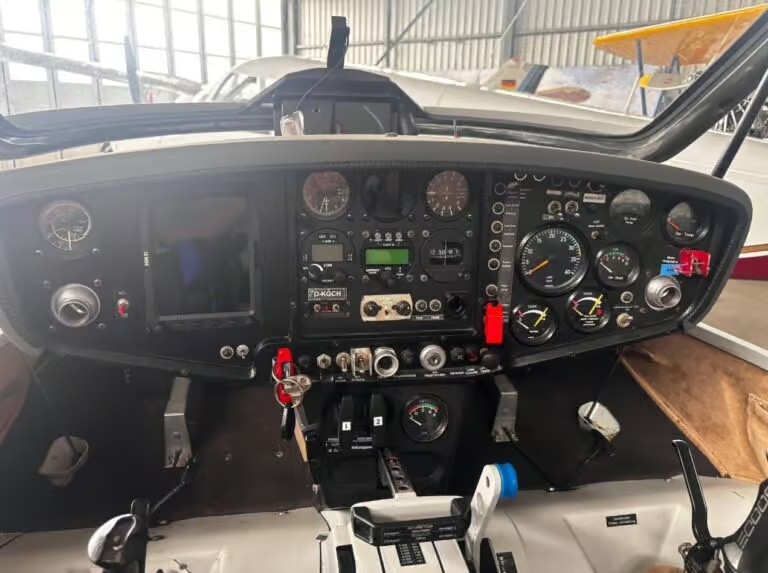
The Diamond DA20i Katana sports a comfortable, spacious cockpit with a choice of leather or sheepskin seating options, four-point safety harnesses and the Garmin G500TXi Glass Cockpit Avionics Suite. The windows allow for excellent visibility.
- Europa Aircraft XS Long Wing (Motorglider)
The Europa Aircraft SX Long Wing (Motorglider) is sold as a kit and is very easy to build with the manufacturers estimating assembly of approximately 1,500 hours. Europa Aircraft recommends that the Long Wing (Motorglider) be fitted with a Rotax engine seeing that it uses Mogas, which is readily available at most airfields and local garages.
The latest version of the Europa Aircraft XS Long Wing (Motorglider) is equipped with fully interchangeable wings, making this touring motor glider a 2-in-1 aircraft. Europa Aircraft offers the XS Long Wing (Motorglider) in two options, making it available in monowheel or tri-gear.
The Europa Aircraft XS Long Wing (Motorglider) is a two-seat composite aircraft that is designed for quick de-rigging and can be safely stored on its trailer in the garage. Europa Aircraft ensures that the XS Long Wing (Motorglider) delivers excellent performance and provides a comfortable cabin with generous baggage capacity.
- Distar UFM 13/15 Lambada
Distar Air is a Czech aircraft manufacturer specializing in the production of light aircraft that are ready-to-fly in kit and amateur construction. One of their most popular aircraft is the two-seater, single engine UFM13/15 Lambada.
The Distar UFM 13/15 Lambada comprises of an all-composite structure, with the fuselage made from carbon glass composite formed by sandwich structure and the flanges of the wing constructed from carbon rosiny. It converts easily from 13m to 15m. It boasts a fuel capacity of two 50l tanks. Distar offers the UFM 13/15 Lambada landing gear configuration in two options: tricycle with controlled nose wheel or two-wheel controlled tailwheel.
- Sonex Aircraft Xenos-B
Designed as a touring long-wing motor glider, the Sonex Aircraft Xenos-B is a two-seater lightweight tail dragger. Sonex offers two engine options – the Aerovee 80hp or the Jabiru 120hp engine and it is equipped with a Sensenich two blade propeller. Complete airframe kits or quick build kits are also available. The Sonex Xenos-B has a unique Y-tail configuration with mixed rudder and elevator controls for superior handling. The Sonex Xenos-B boasts a wingspan of 40ft, and flapless wings with ailerons and spoilers.
- Pipistrel Sinus 912 Flex
Developed and manufactured by Pipistrel in Slovenia and Italy, the Sinus 912 Flex is a side-by-side two-seat motor glider with a 15m wingspan and a glide ratio of 27:1, when the propeller is feathered, providing endless hours in thermals. It has the ability to take-off and land on very short runways. The Pipistrel Sinus 912 Flex has a spacious cockpit and various instrument options.
- Air Atos Wing
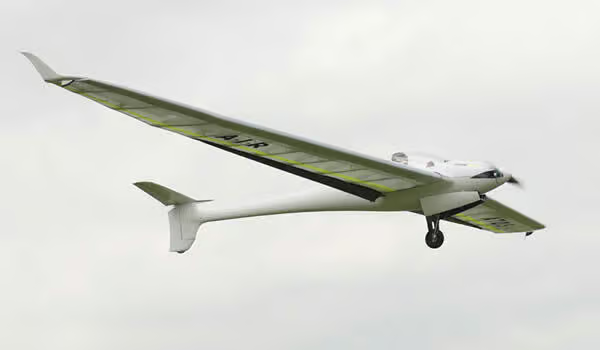
A-I-R Aeronautic Innovation Ruhle & Co GmbH manufactures the Air Atos Wing, a single seat ultra-light electric motor glider used for thermal flying and also almost silent travel motor glider with short starting and landing capabilities.
- AMS Carat A
AMS offers the single seat Carat A powered glider for ideal for soaring or fast cruising and economical to maintain. It is a pure sailplane and touring motor glider in one. Powered by the four cylinders, four stroke Sauer S1800-1ES1C engine, it produces low noise and economical fuel consumption. Rigging can be completed by one person in less than 15 minutes and de-rigged it fits into a normal sailplane trailer. The cockpit is spacious, the instrument panel is VFR equipped and it boasts a baggage compartment that can accommodate up to 150kg (330lbs)
- Diamond DA20i Katana
The Diamond DA20i Katana is mostly used for private flying and is also very popular for use in flight schools. The Diamond DA20i Katana has a two-seat capacity, and it is powered by the Rotax 912iSc3 100hp engine. The spacious cockpit is equipped with bucket seats in leather or sheepskin, four-point inertial reel safety harnesses and the instrument panel boasts the Garmin Glass Cockpit which is EASA certified for Night VFR. The panoramic canopy provides excellent visibility.
- Pipistrel Taurus M and Sinus 912 Flex
Pipistrel manufactures the Taurus M two-seater side-by-side self-launching motor glider with twin landing gear. The Pipistrel Taurus M is powered by a two stroke, two-cylinder engine that produces 50hp and has terrific gliding characteristics. The Pipistrel Taurus M is constructed from composite materials including Kevlar, glass, carbon and epoxy resin. It has a 15m wingspan and can reach up to 88 kts (163km/h) manoeuvring speed.
Also on offer by Slovenian aircraft manufacturer Pipistrel is the Sinus 912 Flex. This too is a two-seat side-by-side glider capable of cross country flying and used for training. The Sinus 912 Flex is powered by the Rotax 912 UL2 80 hp engine. The Pipistrel Sinus 912 Flex has a 15m wingspan and can reach a best glide ratio speed of 51kts (95km/h). The Pipistrel Sinus 912 Flex’s wide canopy provides excellent visibility. Pipistrel’s Sinus 912 Flex has accomplished a multitude aviation achievements, awards and records.
- Stemme Grand Tourer S12-G
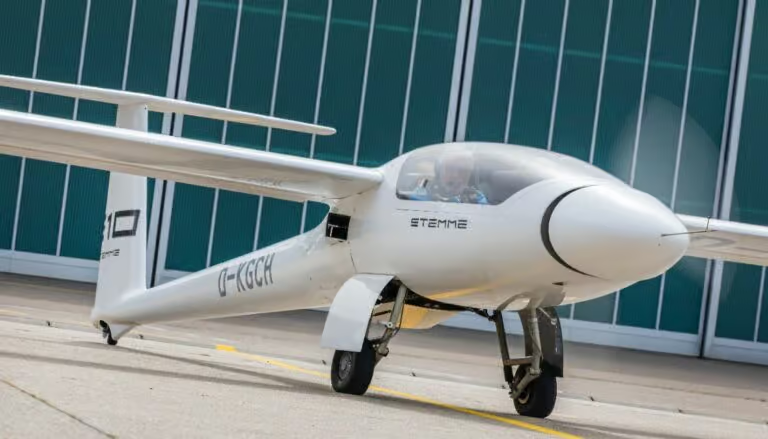
German glider manufacturer Stemme produces the Grand Tourer S12-G. Powered by the Rotax 914F2/S1 Turbo engine, the Stemme Grand Tourer S12-G can reach a cruising speed of 140kts (259km/h) and with its foldable propeller it only takes 5 seconds to convert from glide to engine mode. Avionics are provided by Garmin’s G3X Avionics Suite including autopilot, ADHRS, Moving Map and Digital Engine Monitoring System. Standard on the Stemme Grand Tourer S12-G you will find the AVEO Integrated StarLET System with collision avoidance LED lights.
A Motor glider is a fixed wing aircraft that can be flown with or without engine power. Motor gliders have substantially longer wings than normal light aircraft. Motorized sailplanes are basic flying machines with only a few instruments, the most important being the little cotton thread that is attached to canopy helping you to stay in balanced flight.
Because a motor glider is certified as a glider, pilots can fly without the requirement of a medical certificate as is the case in Light Sport Aircraft. It is left to the pilot’s own discretion to determine whether he or she is fit to fly – self certification.
Motorized sailplanes have an electrical system which allows for the aircraft to be equipped with radios, a GPS system, transponder/encoders allowing flight into Class D airspace.
Motorized sailplanes can glide farther than other types of aircraft, providing for a more confident pilot, increasing broader safety margins. In many cases if you suffer Power Loss After Take-Off (PLATO), you’ll be able to turn back to the airfield and carry-out a safe landing. In the case of the Grob 109B Vigilant, a turn-back following a PLATO was possible from 250 feet.
Rene Fornier designed the two-seat RF-5 comprising of wooden wings and a fuselage constructed with plywood and fabric covering. The Fournier FR-5 received its domestic type certification in the powered sailplane category in March 1969. Production started in 1968 and approximately 200 units were delivered by the time production ended in 1979. Only 32 accidents have been recorded from May 1970 – June 2018 and only 12 fatalities in over 50 years history. An incredibly impressive safety record!
The last recorded fatal accident occurred on the 13th of December 2015 when a pilot accompanied by his daughter took off from Rottweil-Zapfenhain routing to Trier-Fohren collided with a broadcasting tower in Dieblich, Germany, fatally injuring both occupants. Bad visibility and fog were reported at the time of the accident.
With a remarkable safety record the Grob 109B took its first flight in 1981. Initially built as the Grob G109A, the type was upgraded in 1984 to the Grob G109B and over 476 aircraft were built. Only 57 accidents have been recorded spanning over 41 years with 14 fatalities recorded to date.
The last fatal accident occurred on the 10th of June 2018 when a Grob 109B impacted a dead tree whilst conducting a field landing during a training exercise at Usk Airfield, Wales. Although the engine was running during impact, it could not conclusively be determined whether the engine suffered a problem such as carburettor icing during descent. It is considered that the pilots were unaware of the tree until it was too late to avoid. Unfortunately, the pilot and the instructor succumbed to their injuries.
Introduced by Stemme AG (based in Germany) in the late 1980’s, the Stemme S10 is a self-launching two-seater side-by-side sailplane where the engine is mouthed amidships and features a rare folding propeller stored in the aircraft’s nose cone. Since its first flight in 1986, over 36 years 21 occurrences have been recorded and with a total of 17 fatalities.
The worst accident involving the Stemme S10-VT occurred on the 29th of June 2013, when a Cessna 150 collided with a Stemme S10-VT mid-air near Pemberton Airfield, in British Columbia. Both aircraft were completely destroyed. Two occupants travelling in the Cessna 150 and two occupants in the Stemme S10-VT were fatally injured.
German aircraft manufacturer Schempp-Hirth offers the Discus 2cT, a single seat Standard Class sailplane with a 18m wingspan. Powered by a Solo 2350 turbo 2-stroke, 2-cylinder sustainer engine producing only 20.5 hp, the Schempp-Hirt Discus 2cT has a maximum permitted speed of 280 km/h (151 kts).
The Stemme Grand Tourer S12-G is a German high-wing motor glider with two seating capacity. The Stemme Grand Tourer S12-G is powered by the Rotax 914 F2/S1 Turbo engine and has the capacity to cruise at 259 km/h (140 kts).
The feisty little Carat A that is manufactured by AMS Aircraft is a single seater motor glider powered by a Sauer S1800-S1C 4-cylinder, four stroke, air-cooled engine. The AMS Carat A has a VNE of 250 km/h (135 kts), cruises at 230 km/h (124 kts) and delivers its best lift/drag ratio 35:1 at 105 km/h (57 kts).
Diamond Aircraft is an Austrian based aircraft manufacturer that produces the DA-20i Katana. The Diamond DA-20i Katana is powered by a Rotax 912iS3c Sport (100 hp) engine with a maximum cruise speed of 226 km/h (122 kts) .
Golden oldie Fournier RF-5 deserves a mention as one of the fastest motor gliders. The Fournier RF-5 is equipped with a Limbach L2000 EOI four cylinder horizontally opposed air-cooled piston engine (80 hp) VNE is 250 km/h (134 kts) and comfortably cruises at 209 km/h (112 kts).
Because of their elongated wings, motorized gliders burn less fuel - between 2.5 and 5.5 US gallons per hour, depending on the engine type. No fuel is used when the engine is shut off. That means that they can fly farther without using much fuel.
Featuring advanced, modern winglets, the Stemme Grand Tourer S12-G with its optimized aerodynamics delivers an astonishing 1,759 km (950 nm) range and only consumes 13l (3.4 US gal) of fuel when flying at 55% MCP.
Sporty and sleek, the charming Diamond DA20i Katana can comfortably carry two people over a distance of 1,302 km (703 nm), efficiently burning11l/hr (2.9 US gal/hr) when cruising at 8,000 ft (2,438 m) at a 55% setting.
The AMS manufactured Carat A is a single seater powered glider capable of soaring and fast cruising at 230km/h (124 kts) with approximately 1,026km (533nm) range consuming 53l (/13,8 US gal) unleaded premium petrol.
Although not in production anymore, the ever-popular Fournier RF-5 still amazes with an impressive range capacity of 700km – 900km (377nm – 485 nm) and a relatively frugal fuel consumption of 15l/hr (4 US gal/hr) considering its age, delivering an endurance of up to four hours.
Produced by Sonex, the Xenos-B is a delightful two-seater motor powered soaring aircraft that has the capability of covering a great distance of up to 800 km (431 nm). It’s powered by Aerovee 80 hp cruise speed 193 km/h (104 kts) at 8,000 ft (2,483m).
Excellent value for money can be found in the Scheibe Falke motor glider, depending on which variant is available on the market at the time. These wooden tube and fabric aircraft retail from $9,550 to $12,000 on the pre-owned market.
From time to time a Fornier RF-5 all-wooden construction, low winged monoplane seating two in tandem configuration may come to market. Expect to pay between $13,000 and $47,200 for this semi-aerobatic aircraft.
The Austrian Diamond DA-20 Katana, a two-seat general aviation light aircraft can be obtained pre-owned at prices ranging from $30,000 to $50,000 for the 80hp Rotax powered motor gliders and up to $100,000 for the newer versions that are equipped with the more powerful 125 hp engine.
Although it hasn’t been in production for quite some time, the Grob 109B’s heritage and safety record strengthens the resale value of this two-seater self-launching aircraft that dates back to the eighties. Price expectation ranges from $40,000 – $60,000 on the used market.
The Sonex Xenos-B is available as a Quick Build Kit available for as little as $53,000 (Base Price). Major assemblies are pre-constructed with the fuselage and wing of the aircraft being already assembled and riveted, and the canopy being already installed thus reducing build time. Unfortunately, lead times can cause a delay due to popular demand.
AMS Flights d.o.o manufacture gliders, motor gliders and ultra-light aircraft out of Begunje na Gorenjskem in Slovenia. Established in 1999, the company was created to continue with the existing production of aircraft from Elan Flight and to take over production of the Carat A motor glider from Technoflug GmbH.
Chinese-owned Diamond Industries manufacture general aviation aircraft and motor gliders. Based in Austria, it is the third largest manufacturer of aircraft for the general aviation sector with various production plants all over the world. Diamond offers two motor glider options in the form of the DA20-C1 and the Diamond DA20i Katana.
Named after the Brazilian dance, Czech aircraft manufacturer Distar offers the UFM-13/15 Lambada. The Distar UFM-13/15 is a two-seater, shoulder wing motor glider that was originally designed and produced by Urban Air. The aircraft features side-by-side seating and enclosed cockpit with a bubble canopy and T-tail design.
Jonker Sailplanes are based in Potchefstroom, South Africa. Brothers Attie and Uys Jonker founded the company in 2004. Jonker Sailplanes design, manufacture and maintain sailplanes. In 2019 Jonker Sailplanes established Jonker Sailplanes GmbH in Germany in order to expand its activities and business in Europe. Jonker Sailplanes currently have 5 variations on offer: JS1C Revelation, JS2 Revenant, JS3 Rapture, JS4 Rengeti and the JS5 Rey.
Slovenian aircraft manufacturer Pipistrel has its production facility in Ajdovščina and near Gorizia in Italy. Textron acquired Pipistrel in April 2022. Pipistrel offers a wide variety of aircraft to service the General Aviation, Light Sport and Microlight, Gliders and other products. Motorized gliders on offer from Pipistrel include the Taurus Electro, Taurus M and Sinus variants.
Fun Fact: When Slovenia was still part of the former Yugoslavia back in the 1970’s microlight flying was illegal and practically non-existent. Ivo Boscarol and his mates used to secretly make use of a military base, sneaking in an hour or so of flying before nightfall. The powered hang-gliders that they used had triangular shaped wings resembling those of a bat. Local people started calling them “those bats”. In Latin the word “bat” is Pipistrellus!
In most countries the requirement to fly a motor glider is either a Glider Pilot’s Licence or Certification issued by an authorized aviation agent or club that is limited to gliders only, with the exception of Ultra-Light aircraft where applicable.
Canada
A Glider Pilot’s Licence is required for flying unpowered gliders, self-launching motor gliders with retractable engines or propellers and sustainer motor gliders.
An instructor is required to provide instruction and sign off on the pilot’s logbook authorizing the pilot to be able to carry passengers. Motor gliders are classified as gliders and may be operated by glider pilot without obtaining a medical certificate required to operate a motorised sailplane.
USA
A Glider Pilot’s Certificate is required to operate unpowered gliders, self-launching motor gliders with a retractable engine or propeller and flying of sustainer motor gliders.
The instructor must provide instruction and sign the pilot’s logbook to authorize the pilot to utilize the launch method confirming that the pilot is knowledgeable in towing, ground launch by winch, bungee launching, auto towing and in the case of a motor glider, Self-Launching Endorsement.
Motor gliders are classified as gliders in United States of America, therefore a pilot with a Glider Pilot’s Certificate is not required to obtain a medical certificate in order to operate the aircraft.
Europe
Powered gliders are categorized as gliders equipped with a retractable engine/propeller and can be flown with an ordinary Glider Pilots License. Touring motor gliders pilots require an extension to their Glider Pilots License.
In the UK gliding is regulated by British Gliding Association and therefore are not required to be licenced with the UK CAA in order to pilot self-sustaining sailplanes and pure gliders.
A Glider is an unpowered aircraft that is towed by another aircraft with a cable fitted with a release device to an altitude agreed upon prior to take-off. Once the desired altitude is reached, the tow plane pilot releases the glider, freeing the sailplane and the pilot to manoeuvre independently. In the right atmospheric conditions, a glider would effective be able to remain airborne eternally! The sailplane pilot is required to locate updrafts which rise faster than the glider’s descent rate. By using different manoeuvres, the pilot needs to ensure that the sailplane remains in the updraft long enough to gain sufficient altitude to make the lateral distance to the next updraft. Gliders can also be winch-launched.
Motor gliders are essentially motorised gliders which operate in the same fashion as a Single Engine Piston Aircraft. Unlike conventional gliders, motor gliders are able to launch themselves and climb to the desired altitude. Once the desired altitude is reached, the engine and propeller can be shut down and in some cases retracted, converting them into a soaring sailplane that also makes use of the rising updrafts for lateral flight.