


About Booker Aviation
Booker Aviation is an EASA Approved Training Organisation based in High Wycombe, Buckinghamshire. It is ideally situated for individuals wishing to undertake both private and commercial flight training near London and throughout the South-east of England. We are proud to be the first fully compliant EASA ATO based in the UK for PPL Training.
With a fleet of 20 aircraft ranging from our 2 seat trainer Cessna 152s to state of the art glass cockpit Cessna 172s and Diamond DA42 Twinstars we are well equipped to deliver your training whatever your needs. Whether you are looking to purchase a gift trial lesson, take those first few steps towards becoming a commercial pilot, learn to be an Flight Instructor or revalidate your Instrument Rating why not come and visit our friendly staff team and see what we have to offer.
Listings from Booker Aviation

The DA42 is equipped with a G1000 integrated cockpit solution & has single lever power control.
Listed 5 years ago · Updated 5 years ago

Our Piper Arrow, G-BHFJ, is a fully complex aircraft with variable pitch propeller & retractable undercarriage.
Listed 5 years ago · Updated 5 years ago
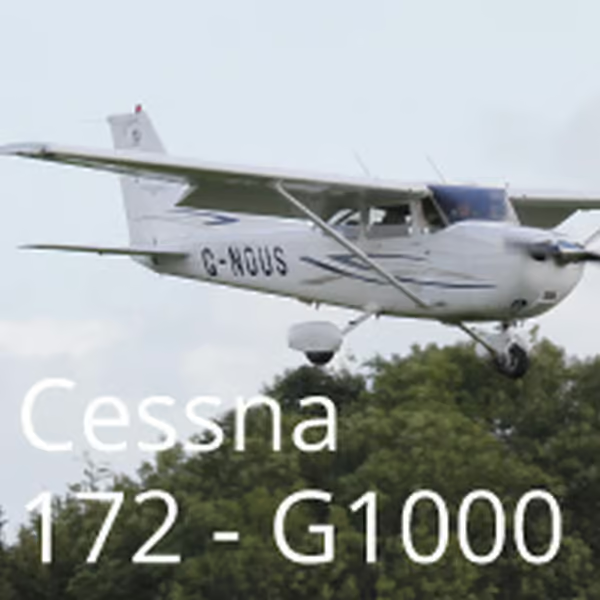
Our Cessna 172, G-VOUS, is fully equipped with a G1000 integrated cockpit with traffic information. This technology is at the forefront of general aviation flying.
Listed 5 years ago · Updated 5 years ago

The Piper Dakota, G-ODAK, has a 6 cylinder engine & variable pitch propeller allowing it to cruise 20-30kts faster than the Piper Warrior.
Listed 5 years ago · Updated 5 years ago

They are primarily used for PPL training, however the Aerobat's are ideal for Flight Instructor training as they can be used for the spinning element.
Listed 5 years ago · Updated 5 years ago
Showing 5 of 5
Couldn't load more.
Services
Learn to fly with us
Whether you are looking to fly for fun or train for a career, Booker Aviation has a solution for you. Conveniently based in High Wycombe, South Bucks.
Modular Training Explained
Booker Aviation specialises in the provision of high-quality modular training offering the flexibility and cost-conscious option for the discerning trainee pilot.
With the modular choice, the student is offered a higher degree of control over their own training programme allowing them to structure the various courses as best fits their own lifestyle. Payment is on a course-by-course basis allowing the student to spread the cost more easily and to better be aware of the outlay at each stage. This allows the option of arranging each course around work commitments, or on a full-time basis as preferred.
At Booker Aviation we have a breadth of experience in offering the bespoke service you need when structuring your modular training so that you minimise training costs and time whilst retaining the flexibility you require to achieve the best possible outcome.
Our Fleet
We operate 8 of these 2 seat trainers 2 of which are Aerobat's.
They are primarily used for PPL training, however the Aerobat's are ideal for Flight Instructor training as they can be used for the spinning element.
We operate 5 of these 4 seat aircraft.
With a higher cruising speed than the C152 they are ideal for our members who wish to visit the near continent or fly further within the UK. They are also available for PPL training.
The Piper Dakota, G-ODAK, has a 6 cylinder engine and variable pitch propeller allowing it to cruise 20-30kts faster than the Piper Warrior.
It is ideal for those pilots looking for the "challenge" of learning to control a more powerful aircraft and tour even further or complete a Single Engine Instrument Rating. G-ODAK has been fitted with a G600 glass cockpit click here to find out more.
Our Cessna 172, G-VOUS, is fully equipped with a G1000 integrated cockpit with traffic information. This technology is at the forefront of general aviation flying. This aircraft is primarily used for touring however is available as an option for Single Engine Instrument Rating training.
For those who prefer traditional avionics, we operate a very nice 172SP, G-OJAG.
Our Piper Arrow, G-BHFJ, is a fully complex aircraft with variable pitch propeller and retractable undercarriage.
It is perfect for Single Engine Commercial Pilot Licence and Instrument Rating training, differences training or touring further afield. G-BHFJ has recently had an avionics refit and now boasts a touchscreen Garmin G650 and Mode-S Transponder making it fully IFR equipped.
We have 3 DA42 twin engine aircraft.
They are used for multi engine piston class rating and Instrument Rating training. The DA42 is equipped with a G1000 integrated cockpit solution and has single lever power control.
Simulators
We have 1 FNPT1 and 1 Alsim AL42 FNPT2 simulators.
They are both used for the simulator elements of the commercial modules. The FNPT1 is approved for both single and multi engine configurations while the FNPT2 is solely used for multi engine training. The FNPT2 is also approved for Multi Engine Instrument Rating revalidations under certain criteria. Contact us for more details.
Airfield Facilities
Wycombe Air Park is open 7 days per week from 09:00 to 17:30 hours. Extended opening hours in the Summer on Saturdays, Sundays until 18:00, Tuesdays and Thursdays until 20:00 hours. In Winter, night flying until 19:00 hours takes place on Tuesday to Thursday evenings (weather permitting). Strictly PPR. Telephone 01494 529261.
WAP hosts all the facilities you would expect from a top class airfield, including Flying Training Organisations, Pilot Supplies Shop, Aviation Medical Examiner, Full Air Traffic Control, Rescue and Fire Fighting Service, and Engineering.
Flying into WAP
The airfield operates without a dead-side to the circuit. Powered aircraft and glider traffic use opposing circuits on the duty runway.
Be prepared to join Downwind or base-leg as directed by Wycombe Tower on 126.555 Mhz. The usual pre-arrival reporting points are Princes Risborough from the North and Henley from the West. You can of course join from any direction but these landmarks will make ATC's instructions to you easier to follow.
The "Golden Ball" monument will also be seen part-way from Risborough to the airfield and this roughly marks the beginning of the Aerodrome Traffic Zone from the North.
There are very strict Noise Abatement Areas to be observed. The departing instructions can be easily dealt with on the ground whilst the arrival procedures will be given very clearly by ATC.
If you are offered an overhead join because the traffic is too busy please remember that there is no dead-side and thus the following procedure will have to be observed. Over-fly the airfield along the centreline of the runway in use at 1200 feet QFE. When overhead the mid-point of the duty runway, turn into the circuit and descend to 1000 feet before reaching the Downwind leg.
The rest is normal!
You should not be put off by these procedures as they are pretty easy once you've had a go and ATC are there to help; not to hinder!!
Gallery


