











The Art of Takeoffs and Landings eCourse
NEW! The Art of Takeoffs and Landing – $59.00 (7+ Hrs.)
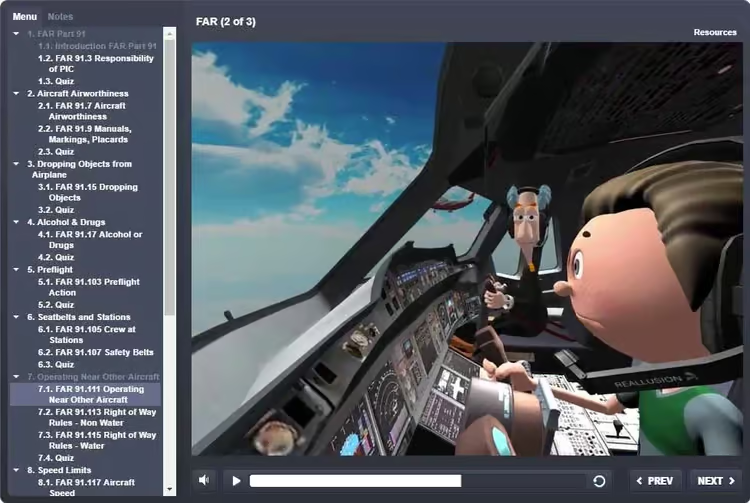
THIS eCOURSE meets all new ACS standards and was entirely created by a flight instructor with 50+ years of flight training experience (no AI used here). Complimentary downloads are available for this eCourse.
Updated to 2026 Standards. You have lifetime access and this course is always current and updated frequently. You can view this eCourse on a PC, Laptop, Mac, iPad, Android Tablet, or smartphone. You can only download eCourse videos to an iPad or Android Tablet for offline viewing.
Improve Your Consistency With Rod’s Proven Techniques:
Takeoffs and Climbs
Approaching to Land
The Roundout and Flare
Crosswinds and Slips
Short and Soft Fields
Wind Gusts and Turbulence
Advanced Landing Concepts
Pitch and Power Flying Technique
And much more…
Price: $59.00
Visit Rod Machado Aviation Learning Center to purchase this exceptional book.
The Art of Takeoffs and Landings eCourse
Disclosure: As an affiliate, AvPay earns a small commission from qualifying purchases made through this link at no extra cost to you.
Description
Learn How To Master the Fundamentals
Every flight starts with a takeoff and ends with a landing, yet many pilots lack the fundamentals to do them consistently because they weren’t properly taught, or they haven’t practiced enough to be proficient.
That’s where this course comes in. If you use it to pick up just one useful takeoff or landing technique, it will be worthwhile because you will use the technique over and over.
But (trust me) there are lots of useful techniques in this course. Some of the techniques Rod teaches are unique while others you may be familiar with, but Rod often puts a different spin on them or provides an example that suddenly makes things crystal clear. In some cases, Rod will validate a technique you are already using and that can be just as valuable.
Good takeoffs and landings start with a solid understanding and good technique — and that’s exactly what Rod delivers in this course.
1. Takeoffs and Climbs
The Big Takeoff Picture
The Trip to the Runway
Get Set
Take It Off—Take It All Off
Climb Attitude and Density Altitude
When To Raise the Landing Gear
Three Engine Power Combinations
Not Crossed Up by Crosswinds
The Effects of Ground Effect
Wingspan vs. Induced Drag
A Soft Spot For Soft/Rough Fields
Short Field Takeoff Demonstration
Soft Field Takeoff Demonstration
Rejected Takeoffs
Why Vx and Vy Change with Altitude
Preventing Serpentining
2. Approaching To Land
Approaching To Land
Getting Low, Getting Down
When Lift is a Drag
When To Turn Onto Base Leg
When To Begin Landing Descent
How Normal Patterns Aid in Landing
What To Do When Turning Base Leg
Finally Turning Final
Power-off Landings
The Stationary Spot
Normal Glidepath/Returning To Glidepath
Too Low/Too High On Final
Trapezoidal Runway Shape Change
The Simple Glidepath Evaluation Clue
What The Runway Shape Means
Glidepath Angles and Power Usage
The Elevator Instinct
Using Approach Speed Charts
3. The Roundout and the Flare
Why Ground Shy?
Sensory Rich Runways
When To Begin the Roundout
Sitting Height
The Sweet Spot
Where To Look When Flaring
How Fast To Flare
The Runway Expansion Effect
The Ultimate Flare Exercise
The Aft Elevator Pull
Proper Trimming
Sampling The Response
The Two-Handed Flare
Touchdown Spot View
Balked Landings
Porpoising, Floating…
Ballooning, Bouncing, Fanning
Landing A Taildragger
4. Crosswinds and Slips
The Crab Method
The Wing Low Method
A 25 Knot Direct Crosswind
Full Flaps Left Crosswind
A 10 Knot Direct Crosswind
Getting Nosey On Touchdown
Transitioning—Crab To Sideslip
The Really Big Guns
Flaps and Crosswind Landings
Weathervaning
Gusts in the Gusts
Getting Down By Slipping Down
Right or Left Slips?
The Slipping Turn
5. Advanced Landing Concepts
Short Field Approach
Short Field Landing—With Obstacle
Short Field Landing—No Obstacle
The Region of Reverse Command
Roundout and Flare On Short Fields
Short Field Demonstration
Soft Field Approach
Soft Field Landing
Soft Field Demonstration
Estimating Stall Speed With Flaps Extended
Approach and Landing In Bumpy Air
6. Pitch and Power Flying Concepts
Pitch and Power Introduction
The Flying Equation: A+P=P
Common “Formula” Mistakes
Flying The Wing
Fine Tuning Attitude With Instruments
The Five Attitudes
Constant Airspeed vs. Glidepath
Fixed Power Condition
Variable Power Condition
Pitch-Power Flying Techniques
Elevator-Airspeed Pilots
Which Technique To Use?